A reoccurring theme in my blogs so far is the mentioning of movies. How did The Hobbit come into my life? Yes, a movie. I apologise, but I must mention one of my favourite movies first: the Lord of the Rings! The book will come later, promise.
I remember the joy and fulfilment that LotR gave me: the characters, the adventures, the mystical place names like Mordor, Rivendell, the Shire, Black Forest and many more. But, after leaving that cinema car park I realised that it was all over, finished! I thought to myself: what is going to be the next big blockbuster movie that grabs my attention. Will they make a sequel to the LotR? Could they bring Sauron back? Unfortunately no, but I felt eager to digest more if it would ever come.
So…many moons later I heard of a book that had been published called The Hobbit! What?! And it is the prequel to the LotR. But, the thing was, the last LotR movie had been released in December 2003.
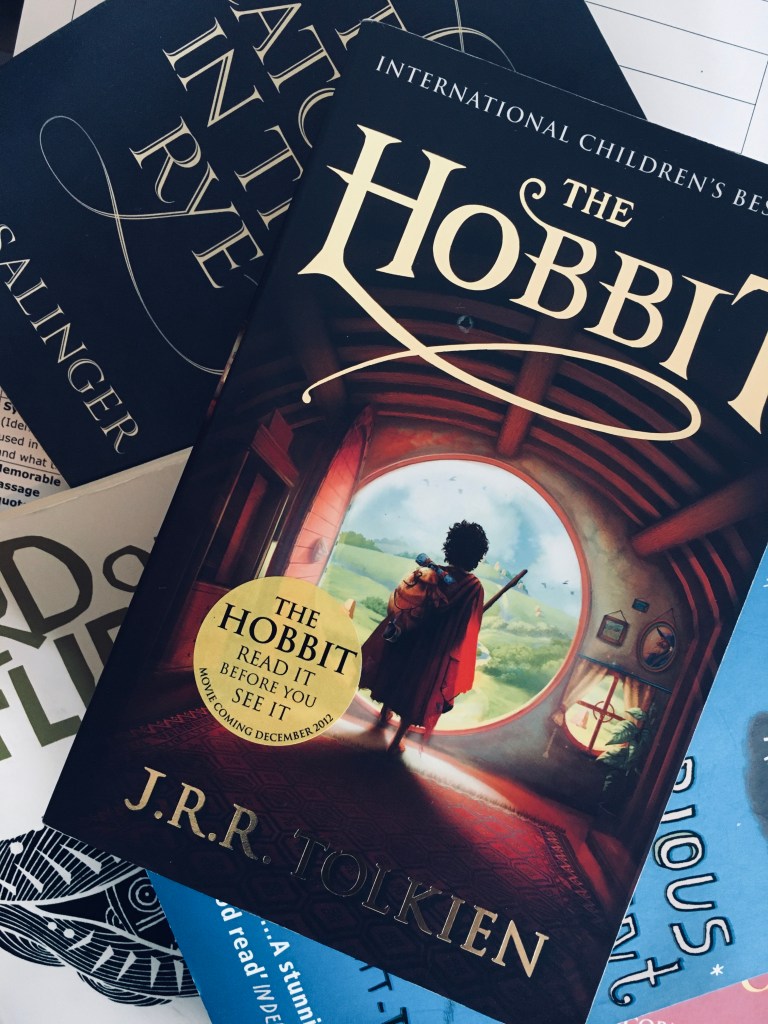
There were two major problems with this…
First of all, it was the midst of the year 2012 and this prequel movie coming in December 2012. Could I wait so long or should I just read the book? The book did seem to suggest that I should read it before I see it (as you can see the yellow sticker on the image on the right).
Secondly, and more importantly: HOW ARE THEY RELEASING A PREQUEL A WHOLE NINE YEARS AFTER THE LORD OF THE RINGS ENDED?!
I soon accepted the weirdness of that last fact, and turned to more important things: should I read it or should I wait another six months to watch it? Honestly…December 2012 quickly approached and I hadn’t read it. Then, ironically I was given it as a gift, and it was actually the note inside that made me read the book…
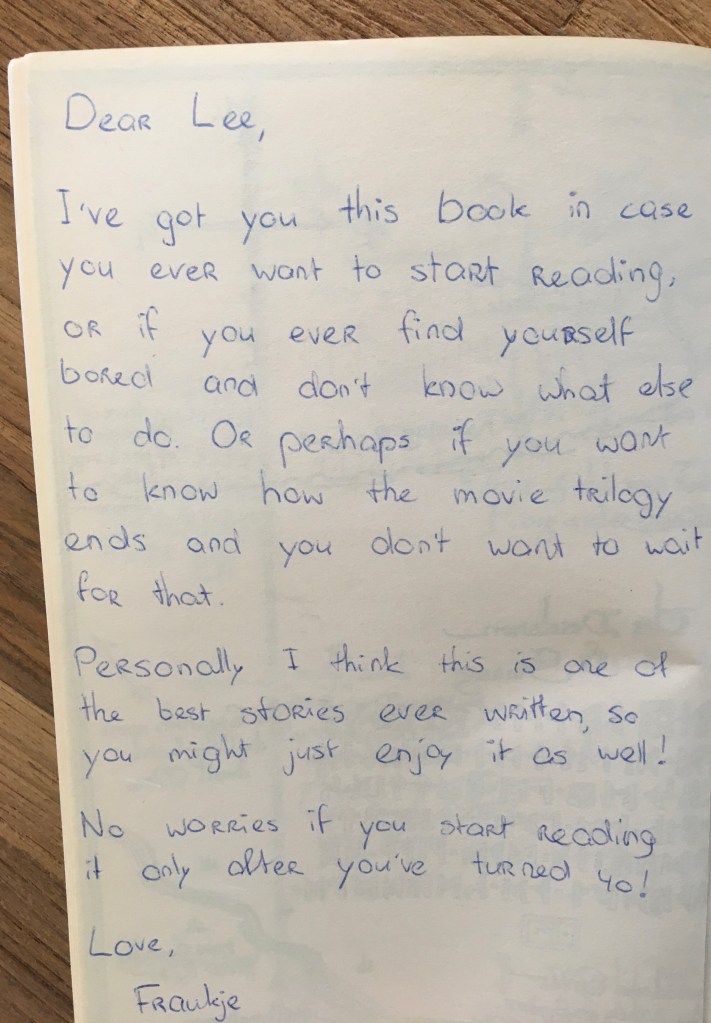
Now, after that, lets get to The Hobbit. As Fraukje mentions in her note, it was truly a great story and a pleasant read. What makes the book intriguing is that I already knew the characters: Bilbo the protagonist, Gandalf the Grey, the egocentric dwarves. These characters were fiction being utilised at its best, or as Austin (2002) said: “Fiction requires a balance between elements of the strange and the familiar”. In the first chapter ‘an unexpected party’, Gandalf, the wizard, sat at the head of the table with 13 dwarves, and a hobbit. Not quite the typical party wouldn’t you say?
The unexpected party was a sneaky way for Gandalf to trick Bilbo into joining an adventure to the Lonely Mountain, to raid the treasure on which Smaug lays. The dwarves being robust yet greedy wanted the treasure back. The journey began from Hobbiton in the West to the Lonely Mountain in the East and back again. Along this “mission…quest…thing” (Jackson, 2001), readers could recognise Bilbo’s character development from a person who felt that adventures were “nasty disturbing uncomfortable things” (Tolkien, 2012, p15) to a more ballsy and lenient hobbit who rescued his dwarf accomplices after being captured by spiders. He had left his easy going, snug life to become daring by stepping out of his comfort zone, going on adventure filled with capture, escape and problem solving situations.
During class discussions, we couldn’t overlook the connection between Bilbo and Gandalf. Gandalf is portrayed as a father and wisdom figure. He knows the challenges that lay ahead will evolve Bilbo’s characteristics, so he provides enough “pocket-handkerchiefs and tobacco” (Tolkien, 2012, p46) for the beginning of the journey that Bilbo can’t turn back. Gandalf instills extreme confidence in Bilbo, almost acting as his teacher before leading the quest, and also without his presence, to the Palace of the Elvenking and Smaug’s Lair. This indicates Bilbo’s growth. Having said this, there are also more conflicting passages, which lead to the question: is Bilbo having an identity crisis? Well, it’s complicated! Even though he needed a little nudge from Gandalf, I would put Bilbo in Erikson’s “moratorium” state, as he is actively involved in exploring this adventure. But as we know from the sequel, Bilbo doesn’t commit to being a journeyman until he hands, or drops the ring to Gandalf and leaves The Shire for Rivendell to stay with the Elves (Erikson, p5). So, he hasn’t really made a commitment, rather, he was happy to be back in The Shire playing invisibility with his magic ring.
Another interesting comment made by my classmate was the realism between The Battle of Five Armies and World War 1. As Austin (2002, p5) puts it, “even the most elevated and fantastic story must possess a certain amount of emotional realism”. Tolkien, after finishing his studies at Oxford, enlisted in the British Army where he spent four months in the trenches, witnessing first hand the “Battle of the Somme” in 1916 (National Archives, n.d). Here, Tolkien was able to bring close resemblances of realism into his fictional book. Therefore, giving this fantasy novel a “true to life” edge so readers can easily imagine similar situations (Appleyard, 1991, p12). Minus the talking trees of course.
The Hobbit cannot be analysed without drawing attention to Tolkien’s narrative style. Written in the third person omniscient, we see the story being told through the eyes of Bilbo. The quote below reveals that the book’s diction is written in an old style.
“Where did you go to, if I may ask” said Thorin to Gandalf as they rode along.
“To look ahead”, said he.
“And what brought you back in the nick of time?”
“Looking behind”, said he.
Tolkien, 2012, P61
Most authors would modernise the above sentences to say ‘said Gandalf’ or ‘replied Gandalf’ and not ‘said he’. Tolkien is staying consistent in Bilbo’s language choice throughout the entirety of the book. One would think that such an old writing style would be difficult for young readers to comprehend. On the contrary, Tolkien’s diction is kept “consistent, simple and relatively formal” so the reader can easily follow (Austin, 2002, p3). As well as that, younger readers will appreciate the motifs; good meets bad, the heroes overcome the challenge and the good triumphs. Taking into account all the fictional elements, the language used and the book’s realism to history, I would recommend this book to children 8 years old and beyond.
This epic fantasy novel did itself justice. Go and read this book! Explore the journey with Bilbo and his crew. Get lost in the fictitious settings and admire a finely written masterpiece of elves and dwarves, goblins and trolls. And if you are anything like me, you’ll be disappointed with the outcome of the movies… because you’ve read the book first.
Lastly, to Fraukje, “thank you” said I!
Bibliography
Appleyard, J.A. (1991). Becoming a Reader. Cambridge. Cambridge University Press.
Austin, A. (2002). Quality in Epic Fantasy.
http://strangehorizons.com/non-fiction/articles/quality-in-epic-fantasy/
Retrieved 25 March 2020.
Erikson, E.H. (1970). Reflections on the dissent of contemporary youth. International Journal of Psychoanalysis, 51, 11-22.
Jackson, P. (2001). The Lord of The Rings: The Fellowship of the Ring. New Zealand. New Line Cinema.
National Archives. (n.d). People: Officer’s Service Record: J.R.R Tolkien.
http://www.nationalarchives.gov.uk/pathways/firstworldwar/people/aageson.htm Retrieved 24 March 2020.
Tolkien, J.R.R. (2012). The Hobbit. Great Britain. Harper Collins.
 A literature blog by Lee