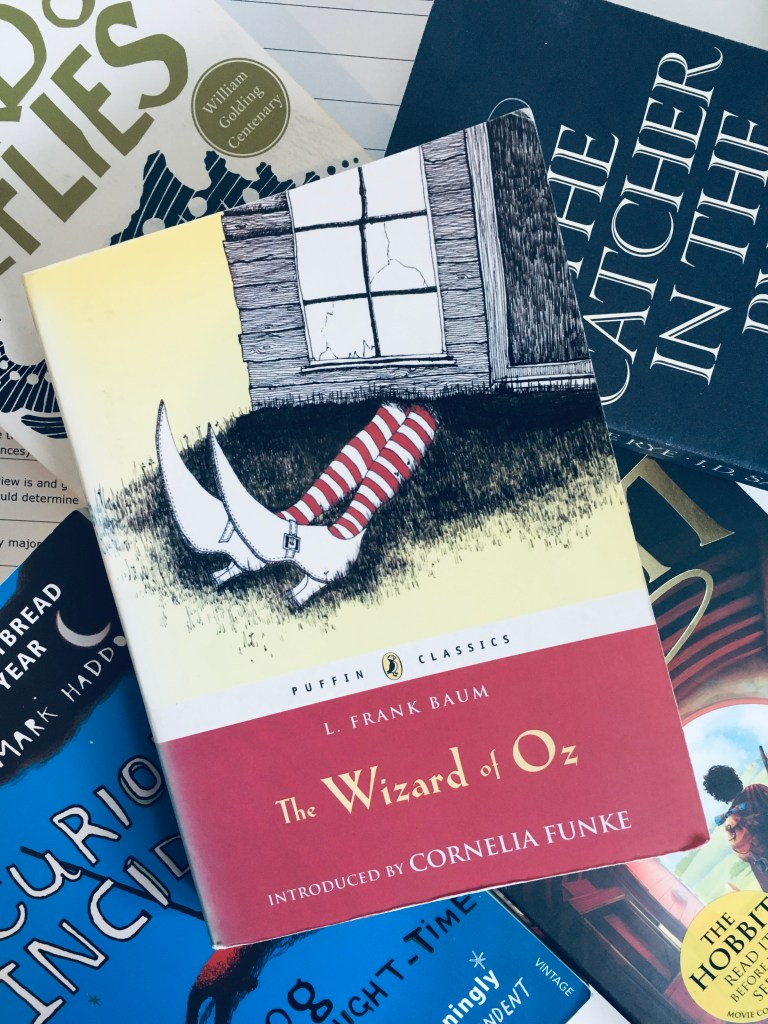
I had already made up my mind that I would read The Wizard of Oz for my literature assignment. It is regarded as a classic book, which seemingly everyone has read at some point in their lives.
Well, I haven’t. My girlfriend came up with a thoughtful idea that we should watch the movie to give me an idea of what to expect. So one evening, relaxing on the couch with crisps and chocolate, we watched the 1939 Wizard of Oz.
I hated it!! I couldn’t see past the square image, the black and white picture, the poor visual effects and dare I say it, the acting! Sorry Judy! Needless to say, I judged the movie by its cover! I wanted the movie to end quickly and doubted my decision to read the book. Nevertheless, people always say the book is better than the movie. In my case, this proved to be true.
“The silver shoes are yours, and you shall have them to wear”
Baum, 2008, p13
My first impression of the book was the actual cover. Didn’t I see Dorothy wearing red shoes in the movie? But in the book she’s wearing silver shoes, one of the many differences between the book and the movie. Anyway, let’s not get bogged down on the movie and focus our attention on the book. I mentioned earlier that the Wizard of Oz is regarded as a classic. Why? It portrays the typical structure that appeals to young readers. But how? Well, generally speaking, the story has the heroic character in Dorothy, who is faced with the problem of wanting to get back to her aunt and uncle in Kansas. She must go on an adventure in the magical land of Oz. Along the yellow brick road Dorothy encounters rather “semi-human figures and creatures” who all have their own problems (Appleyard, 1991, p5).
Yes, said the Woodman, ‘at least I shall get my heart’.
‘And I shall get my brains,’ added the scarecrow joyfully.
‘And I shall get my courage,’ added the Lion thoughtfully.
‘And I shall get back to Kansas,’ cried Dorothy, clapping her hands.
Baum, 2008, p118
Finally, after all the repetitiveness has been overcome, the young reader learns of a happy ever after ending, where Dorothy finds her way back home. These aspects of structure ensure that young readers “can cognitively grasp and affectively identify” with the book (Appleyard, 1991, p5).
In class discussions, we decided that as adults we really do have a different taste in books than we did as a child. In children’s literature, the story is the plot and when children get older, the expected sequence of the plot alters to aid the reader. In saying that, adults could see this book in a different light if they look closely at its symbolisms. In our group discussions, I researched that the book had many elements of political symbolisms. Bahm, before becoming an author, was a political reporter who observed the rise of the Populist movement among farmers in the mid 1890s where they addressed economic issues in the United States (Harvey, 2019). From this perspective, we can see Dorothy as the average American girl who is willing to face the unknown. The Scarecrow without a brain suggests that farmers aren’t as stupid as you’d think and have actually started their own People’s Party. The Tin Woodman represents the high level of unemployment in factories while the Witch can be seen as the financial elite who occupies such places like Wall Street or bankers. The Emerald City aka the White House, occupied by the Wizard, you guessed it… the President of the USA. Are these symbols correctly portraying the characters and settings of politics in the USA? Well, it does make for an intriguing discussion and although the assumptions do fit into the context of the story, young readers between 8-12 years old should enjoy the story from a creative and imaginative perspective. Whereas, the adult readers can look into the nitty gritty of literature elements. In the end, my peers and I can all agree that the book is “uncomplicated and repetitive” alluring to Appleyard’s (1971) structure where evil is always overcome.
“I have been wicked in my day, but I have never thought a girl like you would ever be able to melt me and end my wicked deeds”.
Baum, 2008, p112
The quote above shows Dorothy being perceived as an innocent young girl who has surprised the Witch who stood in her way. However, she is also capable of bringing out the best in others by instilling self-confidence in her relationships with the Lion, the Tin Woodman and the Scarecrow. Dorothy emerges from this story with a strong “sense of self and a feeling of independence and control” (Erikson, 1970). With this, Dorothy is clearly in-between Erikson’s fourth and fifth stages of development, which is something every child goes through. Dorothy strives to overcome obstacles in her way of reaching the Emerald City, while showing a high level of competence. That’s what makes this book appealing for young readers in the age of 8-12 years old. They can relate to the characters and learn that they can explore their own competence and identity.
The Wizard of Oz is a fantastic book, which sends a clear message to young readers, which is: be helpful to the people you meet in your discovery of the world. Anything can happen along your adventure in realising your true identity. Wise words from this wanderer would be to remember who you are and where you come from, because at the end of the day, “there’s no place like home” (Wizard of Oz, 1939).
(And yes that is a quote from the movie, which I did watch till the end)
Bibliography
Appleyard, J.A. (1991). Becoming a Reader. Cambridge: Cambridge University Press
Baum, L. F. (2008). The Wizard of Oz. London: Puffin classics.
Baum, L. F. (1939). The Wizard of Oz. Hollywood, California: Metro Goldwyn Mayer.
Erikson, E.H. (1970). Reflections on the dissent of contemporary youth. International Journal of Psychoanalysis, 51, 11-22.
Harvey, I. (2019). The Political and Economic Symbols Hidden Inside the Wizard of Oz. Retrieved from: https://www.thevintagenews.com/2019/04/12/wizard-of-oz-symbolism/
Magnet Theater. (2005). Retrieved from: https://www.google.com/search?q=theres+no+place+like+home&sxsrf=ACYBGNQbOhMliENTGuOf2xbeXx4bOy5HRQ:1581775873541&source=lnms&tbm=isch&sa=X&ved=2ahUKEwjT2rmo3tPnAhUHuRoKHYKxDKkQ_AUoAXoECBIQAw&biw=1280&bih=640#imgrc=H-jaRPiY18Xr8M
 A literature blog by Lee
Should I congratulate you on finishing the film? ;-). You are definitely on the right track with this blog. I like how you have connected some of the theory to the novel and come up with a clear age group at the end of your blog – which is based on some points made on characterisation and plot. Interesting how you also point out in what way the novel is interesting for adults. You show insights into the possible symbolisms in the novel and have used examples from the book. Well done!
LikeLike